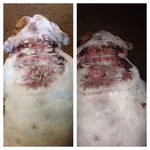
Aww poor baby, I'm so sorry you're going through this with Winston. Most allergies come from food and the wrong protein source or grains and other fillers. Many bullies are allergic to chicken and salmon and are sensitive to grains, corn, potatoes and other fillers. Which brand of food are you currently feeding him? My female Blossom is allergic to chicken, salmon, and beef, we switched her food 4 times before we found one that she tolerated and didn't cause allergy symptoms. We are currently feeding Fromm's Lamb and Lentil to our guys with food results. It looks like the sores may be hot spots that keep spreading, it takes time, patience and consistentcy to treat these hot spots to clear them up. Using Prednisone and Antibiotics work short term, and only while they are on the mediation, it is not good to use these long term, as they cause more problems. The first step is to determine what the allergen is, food or environment, and try to avoid them. You can give Winston some supplements to boost his immune system as allergies are caused by an abnormal response of the immune system, so by boosting it, you help fight allergy symptoms, infections, and parasites. I give our guys 2 Tbsp of plain unsweetened yogurt on their morning kibble everyday, for the probiotics and the immune system, I also give them 1 Tbsp of apple cider vinegar in their drinking water everyday, there are many health benefits to ACV. It is a natural anti inflammatory as well as a natural anti bacterial and anti fungal. It kills the bad bacteria in the body, so boosts the immune system, I also give them 1Tbsp of Coconut Oil for the Omega Fatty Oils, which are beneficial for skin, coat, bones, joints and the brain. If trying or starting any of these supplements, try one at a time for a week before starting the next one, so you will know if he has a reaction to one of them, then you will know right away which one he doesn't tolerate. To great his skin, you may want to put him on antibiotics first, since it's quite sore and weepy looking, and it's best to shave the whole area where the hot spots are so they can be exposed to the air. They need to be kept clean and dry to heal. You can use some medicated shampoos ( ask your vet for some recommendations), and rinse him with equal parts of warm water and white vinegar, again this is a natural anti bacterial and will help heal his skin, you can also use Epsom salts and warm water as well. I hope you are able to clear his skin up, and he feels better soon. Please keep us posted on how he's doing.
Hot Spots on Dogs: Causes and Treatment
Hot spots are an irritating skin condition that affects countless dogs every year. Here, Dr. Henry Cerny, DVM, MS of Yankee Hill Veterinary Hospital, answers some common questions about hot spots.
What are hot spots on dogs and how can we detect them?
A hotspot (also known as pyotramatic or moist dermatitis) is a condition which involves an area of skin which has become inflamed and infected. The affected skin often appears as a moist, oozing, reddened area that is painful and very itchy to the dog. Hair loss may also be seen. Continued licking and chewing at the area by the dog worsens the condition dramatically.
What causes hot spots and can they be prevented?
Anything that causes itchiness of the skin can lead to the development of hot spots on dogs. Some common triggers are atopy (allergies to things in the environment such as grasses, trees, weeds, dust mites, etc), food allergies, fleas, mites, insect bites and skin wounds. A bacterial infection of the skin (typically caused by staph) develops by taking advantage of the damaged inflamed skin. The infection is often deep in the dog's skin and, in addition to the moist oozing appearance, an odor is often present.
How are hot spots treated?
The goal to treatment is to clear the bacterial infection, relieve the itching and pain, and identify and remove the underlying triggers if possible. The hair in and around the dog's hot spot is usually clipped to allow initial cleaning of the area and the application of topical medications. Topical treatment with sprays, creams or ointments to kill bacteria and help with pain and inflammation are often used. Oral antibiotics are usually prescribed for a course of three to four weeks and sometimes longer. Often a short course of corticosteroids (i.e. prednisone) is given to relieve the itching and pain due to the inflammation. Antihistamines may also be used to help with itchiness.
Would Vetericyn be helpful in the treatment of hot spots on dogs?
Yes. Vetericyn liquid or hydrogel can be applied topically to kill bacteria and help cleanse the wound and speed healing without depleting vital moisture from the skin. It has the additional benefits of being non-irritating, non-toxic and non-staining to your dog's skin or dog's haircoat.