Daily brushing is the best I have found to combat shedding, bullies are sheeders so keep that brush handy. I found this interesting article about fruits and veggies in dogs.
By Moira Clune, eHow Contributor
- Benefits
- Dr. Debbie Knapp, a veterinary medical oncologist and researcher in the Department of Veterinary Clinical Sciences at Perdue Cancer Center studies invasive urinary bladder cancer (invasive urothelial carcinoma or InvUC) in dogs. Among her findings was the "...reduction in InvUC risk attributed to ingestion of vegetables. In fact, dogs in the study who consumed vegetables at least 3 times per week had a 70 percent reduction in bladder cancer risk."
Dangers
- There are some fruits and vegetables that are unsuitable and even toxic to dogs. Corn is a common allergen and can cause stomach upset. Grapes, avocados and onions can cause more serious conditions. The ASPCA has advised against feeding grapes because "although the toxic substance within grapes and raisins is unknown, these fruits can cause kidney failure." and points out that "The leaves, fruit, seeds and bark of avocados contain Persin, which can cause vomiting and diarrhea in dogs." Onions, the site states "can cause gastrointestinal irritation and could lead to red blood cell damage.
Choose Quality
- Whenever possible, opt for organic. If the cost of an all-organic diet is prohibitive, consider avoiding the produce on the "dirty dozen" list and going for the "clean 15". The "dirty dozen" fruits and vegetables have been found to be the most contaminated by pesticide residues. According to the Environmental Working Group, pets and "people can lower their pesticide exposure by almost 80 percent by avoiding the top twelve most contaminated fruits and vegetables and eating the least contaminated instead."
Preparation
- Dogs have a short digestive tract and lack the type of teeth needed to effectively grind food. Dr. Christina Chambreau, a homeopathic veterinarian and holistic educator, suggests pureeing fruits and vegetables in a juicer or food processor to aid nutrient absorption. Very fibrous vegetables can be cooked for 10 to 15 minutes to break them down enough the digest more easily.
Variety
- Feed a broad variety of fruits and vegetables in a wide range of colors for the best possible nutrition. Some of the most dog-friendly vegetables are peas, carrots, squash, green beans and sweet potatoes. Fruits may require a little more encouragement, but many dogs like melon, bananas, apples, peaches and pears.
Strictly Vegetarian?
- Dogs are omnivores, not carnivores, and can survive and thrive on a well-crafted vegetarian diet. Care must be taken to provide adequate protein, vitamin D, calcium and essential amino acids. There are commercial vegetarian dogs foods available that are complete and balanced. If you choose to home prepare a vegetarian diet, speak with a veterinary nutritionist for the best outcome for your dog.
Here's some night-time reading for ya:
Myth: DOGS ARE OMNIVORES.
This is false. Dogs are carnivores, not omnivores. Dogs ARE very adaptable, but just because they can survive on an omnivorous diet does not mean it is the best diet for them. The assumption that dogs are natural omnivores remains to be proven, whereas the truth about dogs being natural carnivores is very well-supported by the evidence available to us.
1.) Dentition
Look into your dog or cat's mouth. Those huge impressive teeth (or tiny needle sharp teeth) are designed for grabbing, ripping, tearing, shredding, and shearing meat (Feldhamer, G.A. 1999.
Mammology: Adaptation, Diversity, and Ecology. McGraw-Hill. pg 258.). They are not equipped with large flat molars for grinding up plant matter. Their molars are pointed and situated in a scissors bite (along with the rest of their teeth) that powerfully disposes of meat, bone, and hide. Carnivores are equipped with a peculiar set of teeth that includes the presence of carnassial teeth: the fourth upper premolar and first lower molar.
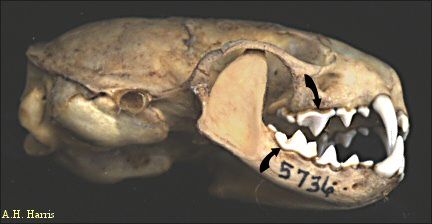
This is the skull of a weasel (also in Order Carnivora), courtesy of
Centennial Museum. The carnassial teeth are marked with black arrows. You can find these same teeth in the mouth of your dog or cat or ferret.
Contrast this with your own teeth or the teeth of a black bear. A black bear is a true omnivore, as are we. We have nice, large, flat molars that can grind up veggies. Black bears, while having impressive canine teeth, also have large flat molars in the back of their mouth to assist in grinding up plant matter. Dogs and most canids lack these kinds of molars. Why? Because they don't eat plant matter. Teeth are highly specialized and are structured specifically for the diet the animal eats, and the difference between a bear's teeth and a dog's teeth (both species are in Order Carnivora) demonstrates how this can be (Feldhamer, G.A. 1999.
Mammology: Adaptation, Diversity, and Ecology. McGraw-Hill. pgs 260.). To see a visual comparison of the teeth of a dog to the teeth of a black bear, please click
here. One can logically ask: If a dog (or cat or ferret) has the dentition of a carnivorous animal, why do we feed it pelleted, grain-based food?
2.) Musculature and external anatomy
Dogs (and cats) are equipped with powerful jaw muscles and neck muscles that assist in pulling down prey and chewing meat, bone, and hide. Their jaws hinge open widely, allowing them to gulp large chunks of meat and bone. Their skulls are heavy, and are shaped to prevent lateral movement of the lower jaw when captured prey struggles (the mandibular fossa is deep and C-shaped); this shape permits only an up-and-down crushing motion, whereas herbivores and omnivores have flatter mandibular fossa that allows for the lateral motion necessary to grind plant matter (Feldhamer, G.A. 1999.
Mammology: Adaptation, Diversity, and Ecology. McGraw-Hill. pgs 258-259.). Consider this quote from the previously-cited Mammology text:
"Canids, felids, and mustelids subsist mainly on freshly killed prey. These families show correspondingly greater development in 'tooth and claw'; they also have greater carnassial development and cursorial locomotion." (pg 260)
This translates to a simple fact: everything about a dog or cat's body design says they were designed for a carnivorous, hunting lifestyle geared toward killing prey. However, humans have done some major tinkering with this body design (resulting in varying sizes and conformations), but we have done nothing to change the internal anatomy and physiology of our carnivorous canines.
3.) Internal anatomy and physiology
Dogs and cats have the internal anatomy and physiology of a carnivore (Feldhamer, G.A. 1999.
Mammology: Adaptation, Diversity, and Ecology. McGraw-Hill. pg 260.). They have a highly elastic stomach designed to hold large quantities of meat, bone, organs, and hide. Their stomachs are simple, with an undeveloped caecum (Feldhamer, G.A. 1999.
Mammology: Adaptation, Diversity, and Ecology. McGraw-Hill. pg 260.). They have a relatively short foregut and a short, smooth, unsacculated colon. This means food passes through quickly. Vegetable and plant matter, however, needs time to sit and ferment. This equates to longer, sacculated colons, larger and longer small intestines, and occasionally the presence of a caecum. Dogs have none of these, but have the shorter foregut and hindgut consistent with carnivorous animals. This explains why plant matter comes out the same way it came in; there was no time for it to be broken down and digested (among other things). People know this; this is why they tell you that vegetables and grains have to be preprocessed for your dog to get anything out of them. But even then, feeding vegetables and grains to a carnivorous animal is a questionable practice.
Dogs do not normally produce the necessary enzymes in their saliva (amylase, for example) to start the break-down of carbohydrates and starches; amylase in saliva is something omnivorous and herbivorous animals possess, but not carnivorous animals. This places the burden entirely on the pancreas, forcing it to produce large amounts of amylase to deal with the starch, cellulose, and carbohydrates in plant matter. Thus, feeding dogs as though they were omnivores taxes the pancreas and places extra strain on it, as it must work harder for the dog to digest the starchy, carbohydrate-filled food instead of just producing normal amounts of the enzymes needed to digest proteins and fats (which, when fed raw, begin to "self-digest" when the cells are crushed through chewing and tearing and their enzymes are released).
Nor do dogs have the kinds of friendly bacteria that break down cellulose and starch for them. As a result, most of the nutrients contained in plant matter—even preprocessed plant matter—are unavailable to dogs. This is why dog food manufacturers have to add such high amounts of synthetic vitamins and minerals (the fact that cooking destroys all the vitamins and minerals and thus creates the need for supplementation aside) to their dog foods. If a dog can only digest 40-60% of its grain-based food, then it will only be receiving 40-60% (ideally!) of the vitamins and minerals it needs. To compensate for this, the manufacturer must add a higher concentration of vitamins and minerals than the dog actually needs.
Is the dog an omnivore? Its dentition, internal and external anatomy, and physiology say it is not. Even its evolutionary history says the dog is a carnivore. They are descended from the carnivorous wolves. So when people tell you the dog is an omnivore, ask: "What about this animal makes you think it is an omnivore?" Make them explain their position to you before you explain yours. Chances are they'll cite as "proof" another myth about wolves eating the stomach contents of their omnivorous prey. They may eat stomach contents but not on purpose - they eat a bit of it in the process of eating the stomach wall.
So why do our dogs eat fruits and vegetables now? That's because in the process of domesticating the dog, we, the humans, feed the dog fruits and veggies. Basically, we made them omnivores.
Ball Pythons have not been in the pet trade as long as dogs. But even then, you will see the modification humans has made in the attempt to feed the ball python. Ball Pythons are ambush predators, they are not scavengers. But, you will see that in many parts of the world, it is illegal to feed pet ball pythons live prey, therefore, they feed them dead rats as if they were scavengers. There is only a very slight nutritional difference between live prey and dead prey, a little bit more difference but not significant for frozen/thawed prey, so pet owners don't fight the ban. But, psychologically, there is a bigger difference because ball pythons hunt and constrict which is not necessary when they are fed dead food. And, interestingly, there is a certain group that is trying to create ball python "sausages". So, fast forward 15,000 years - as long as dogs have been domesticated - you might then have a debate, "Are ball pythons constrictors?"...
Just my 2 cents.