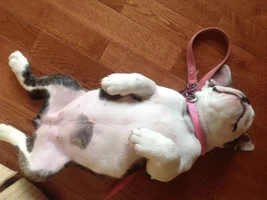
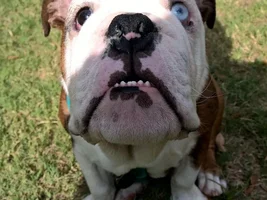
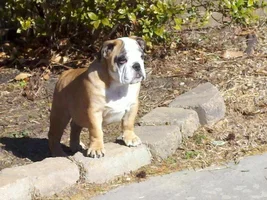
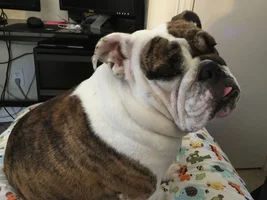
We've been training Bullie ever since we got her 3 weeks ago. Today is her 3-year-old bday and so far, we're making progress but she's not consistent on it yet. What makes it difficult is just trying to get her to understand where she's supposed to be at.
You can train your puppy as early as 8 weeks old. But be careful. A lot of people tend to think lead training is yanking on your dog's collar to get him to "heel". This is not recommended by a lot of trainers and this is very dangerous for a puppy. Even when you got a 3-year-old bulldog with skin so thick you think you need a pinch collar to lead train. Not a good idea in my opinion. We don't use choke collars, pinch collars, shock collars, squeak collars, etc. to lead train. Scaring/hurting the dog to heel is just not necessary.
But yes, bulldogs are super stubborn - hence it's been 3 weeks and we're not even close to there yet. My bichon frise took a week - but then he was a puppy when we started.
So... how to do it. This is what we do:
1.) Start the training before you start taking him out for walks. The first thing you need to teach him is to "heel". So, first you need to pick which side you want the dog to go. Then, in your house or your yard or driveway, etc., tell him to heel and encourage him to go to that side of you facing where your feet are pointing (this is the part that we've been working on for 3 weeks - she doesn't doesn't understand it yet!). When he goes to that side, give him praise and reward. Do this over and over (no need for lead yet).
2.) When he's consistent with "heel", second step is to introduce the lead. My dog is put on a lead to go bathroom (we don't have a fence), so the lead has several meanings for her, all of which does not equate to heel. So, if you've used the lead for something else before, you will notice that when you first use the lead, it's like he never heard of the word "heel" ever. So now, the next step is to remind him of the "heel" command with the lead. Don't walk yet! Just do the heel while you're stationary and the lead is slack. By the way, it's not a good idea to use the retractable leash for lead training a bulldog - the dog is much stronger than the retractable! Use the el-cheapo nylon leads. It's better.
3.) Walking forward. So, when he gets consistent with "heel" on the lead, move forward a few steps. More often than not, the dog will either not move, or move forward ahead of you. If he doesn't move, encourage him to go to your side with the "heel" command and continue walking. If he moves ahead of you, issue the "heel" command and turn to walk a different direction. Be careful with a puppy - they're rambunctious and can start running forward and when you turn to walk a different direction, you could potentially yank his bones. Anyway, when you turn, don't yank on the lead and don't yell "heel" in a panic. Just turn the other way and say heel - if he's excited, you'll probably be saying "heel" just as he runs past you, and you'll need to turn again... Just do this over and over - just a few steps forward and heel - with lots of praise and reward when he stays by your side. Note, this is not a "walk" yet. You're just training - not going somewhere - preferably inside your house so there's no distractions. When he's consistent with that, then you're ready for a walk.
4.) Finals. So, time for the real walk. Plan for a short walk - like to the end of the block then back. Do the same thing you've been teaching him but this time you will have the added challenge of new smells, fire hydrants, squirrels running up the tree, joggers, and other dogs... he's probably going to pull on the lead. Don't yank on it. Just turn to go a different direction and your dog will soon realize he's not going anywhere until he turns too. Keep walking and give lots of praise and reward when he is by your side. After a while of this, he's going to stay by your side everywhere you go.
Now for the disclaimer: I've done this training with a German Shepherd, Doberman Pinscher, Lhasa Apso, and a Bichon Frise with success. We haven't really succeeded in training our 3-year-old adopted bulldog yet.


 Her!!
Her!!