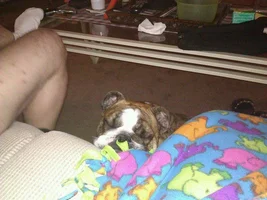
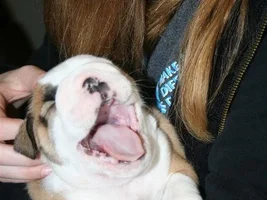
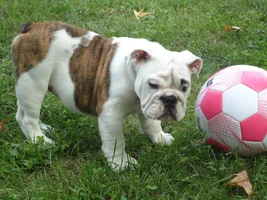
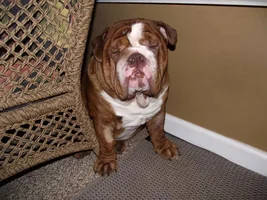
I am the google queen lol..If i dont know the answer i always google till i find it. This is some results from my search
Not necessarily wrong – most bulldogs have a minor form of sleep apnea
(like most overweight humans do). If you have not done so already, take your boy to a vet specializing in (or at least VERY familiar with) brachycephalic breeds and have them check for an elongated palate or crimped snares (extremely narrow nostrils), which would make breathing harder for him – and would be more noticable during heavy sleepingRecent work indicates that upper airway dilator muscles of individuals with obstructive sleep apnea syndrome (OSAS) demonstrate an increased level of activity during wakefulness compared with normal subjects. In addition, massive bursts of pharyngeal dilator activity are associated with the termination of upper airway occlusive events during sleep. This complex pattern of altered pharyngeal dilator activation is also observed in the English bulldog, an animal model of OSAS. In the present study, it was hypothesized that such alterations in activity level might lead to changes in the structure of pharyngeal muscles in the bulldog. Full-thickness biopsies were obtained from two pharyngeal dilator muscles, the sternohyoid (SH) and geniohyoid, as well as a limb muscle, the anterior tibialis, in bulldogs (n = 5) and control dogs (n = 7). Immunohistochemical analysis of myosin heavy chain expression revealed an increased contribution of fast type II myosin heavy-chain fibers to SH in bulldogs. The bulldog SH also demonstrated increased connective tissue content compared with control dogs, consistent with the presence of fibrosis. Both pharyngeal dilators in the bulldog exhibited an elevated proportion of morphologically abnormal fibers indicative of ongoing or prior injury. No differences in any of the above parameters were seen between bulldogs and control dogs in the anterior tibialis limb muscle. We conclude that the chronic load and altered pattern of usage imposed on the upper airway dilators in OSAS lead to myopathic changes that may ultimately impair the ability of these muscles to maintain pharyngeal patency
/